Core Advantages of Hybrid Inverters
I. Integrated Functions, Simplified System
It integrates functions such as photovoltaic inversion, energy storage management, and battery protection. There is no need to additionally match controllers, PCS and other equipment. The wiring is simple, the installation is convenient, there are fewer fault points, and the system complexity is greatly reduced. It is especially suitable for household scenarios and small industrial and commercial places with limited space and no desire for cumbersome wiring.
II. Grid-connected and Off-grid Dual Modes, Stable Power Supply
It supports seamless switching between grid-connected and off-grid modes. When the power grid is normal, photovoltaic power is prioritized for self-use, and the surplus power is stored in the battery or connected to the grid; when the power grid is cut off, it switches to off-grid mode in milliseconds to ensure continuous power supply for key equipment and solve the problem of power outages. It is suitable for rural areas and mountainous areas with unstable power grids, as well as shops and small factories that require continuous power supply.
III. Energy Saving, Cost Reduction and Income Improvement
Surplus photovoltaic power can be stored in the battery for use at night, on cloudy days or during peak electricity price periods, realizing peak shaving and valley filling to reduce electricity expenses; at the same time, it improves the photovoltaic self-consumption rate, reduces dependence on the power grid, and the surplus power can also be connected to the grid for profit. It is suitable for urban households with high electricity bills and industrial and commercial users with large electricity consumption.
IV. Flexible Adaptability and High Cost Performance
Photovoltaic can be installed first, and batteries can be added later for flexible expansion to protect the initial investment; a single device covers a small area, suitable for various scenarios such as households and industrial and commercial use. The comprehensive cost of equipment, construction and maintenance is lower, and it is more cost-effective for long-term use. It is especially suitable for users with limited budgets who plan to gradually improve their photovoltaic energy storage systems.
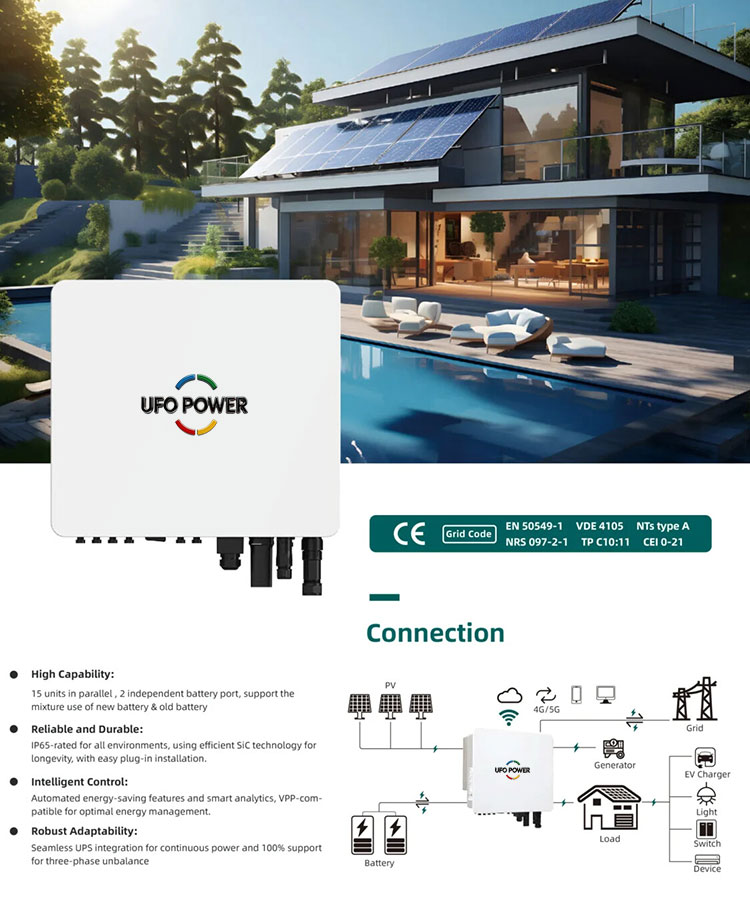
Core Advantages of Hybrid Inverters
I. Integrated Functions, Simplified System
It integrates functions such as photovoltaic inversion, energy storage management, and battery protection. There is no need to additionally match controllers, PCS and other equipment. The wiring is simple, the installation is convenient, there are fewer fault points, and the system complexity is greatly reduced. It is especially suitable for household scenarios and small industrial and commercial places with limited space and no desire for cumbersome wiring.
II. Grid-connected and Off-grid Dual Modes, Stable Power Supply
It supports seamless switching between grid-connected and off-grid modes. When the power grid is normal, photovoltaic power is prioritized for self-use, and the surplus power is stored in the battery or connected to the grid; when the power grid is cut off, it switches to off-grid mode in milliseconds to ensure continuous power supply for key equipment and solve the problem of power outages. It is suitable for rural areas and mountainous areas with unstable power grids, as well as shops and small factories that require continuous power supply.
III. Energy Saving, Cost Reduction and Income Improvement
Surplus photovoltaic power can be stored in the battery for use at night, on cloudy days or during peak electricity price periods, realizing peak shaving and valley filling to reduce electricity expenses; at the same time, it improves the photovoltaic self-consumption rate, reduces dependence on the power grid, and the surplus power can also be connected to the grid for profit. It is suitable for urban households with high electricity bills and industrial and commercial users with large electricity consumption.
IV. Flexible Adaptability and High Cost Performance
Photovoltaic can be installed first, and batteries can be added later for flexible expansion to protect the initial investment; a single device covers a small area, suitable for various scenarios such as households and industrial and commercial use. The comprehensive cost of equipment, construction and maintenance is lower, and it is more cost-effective for long-term use. It is especially suitable for users with limited budgets who plan to gradually improve their photovoltaic energy storage systems.