| Model | Rated voltage | Rated capacity | Battery type | Application | Cycle life | Working
temperature (℃) | Cathode Materiall |
| UFO-GDC11Ah | 4S 15.8V /6S 23.7V
8S 31.6V | 11Ah | solid state | Drone | 1000 times | -20 to 60 °C | NMC |
Core Advantages of High-Power Batteries for UAVs
High-power batteries are the core component of the UAV power system. Different from ordinary energy storage batteries, their core characteristics focus on "high-rate discharge, stable output, and adaptation to complex working conditions". They are especially suitable for UAV types with high power performance requirements, such as multi-rotor and vertical take-off and landing (VTOL) UAVs. The following details the core advantages point by point, balancing professionalism and practicality.
. High Current Discharge for Stronger Power Output
The most prominent advantage of high-power batteries is their support for high-rate discharge, usually reaching 20C, 30C or even higher. They can release a large amount of current in a short time to provide sufficient power for UAVs. When a UAV takes off, climbs, flies against the wind, or performs rapid acceleration, the demand for power increases sharply. Ordinary batteries are prone to insufficient power and voltage drop, while high-power batteries can stably output large currents, ensuring a crisp take-off, powerful climbing, and stable flight even for heavy-load UAVs or large-propeller UAVs, completely solving the pain point of "weak power and inability to fly".
. More Stable Voltage for Safer Flight
Voltage stability is crucial for UAV flight safety. With excellent internal resistance control, high-power batteries have extremely small voltage drop during high-current discharge and can always maintain stable voltage. This feature can effectively avoid problems such as flight control system failure, image transmission interruption, and gimbal jitter caused by sudden voltage drops, and prevent dangerous situations such as UAV power limitation, altitude drop, and loss of control. Whether it is long-term hovering operation or high-intensity flight in complex environments, high-power batteries can provide stable power support for various electronic components of the UAV, greatly improving flight safety and reliability.
. Lower Heat Generation for Longer Service Life
High-power batteries adopt high-quality cells and optimized structural design, and their internal resistance is much lower than that of ordinary batteries. The smaller the internal resistance, the less heat generated during high-current discharge. This not only avoids problems such as bulging and accelerated aging of the battery due to overheating, but also effectively extends the cycle service life of the battery. In scenarios such as continuous UAV operation and high-intensity flight, high-power batteries can maintain a low operating temperature, with stable discharge performance without attenuation, reducing the frequency of battery replacement, lowering long-term use costs, and avoiding potential safety hazards caused by battery overheating.
. Strong Adaptability, Suitable for Multi-Rotor and VTOL UAVs
The core design of high-power batteries is to adapt to the complex flight conditions of UAVs, especially suitable for multi-rotor and vertical take-off and landing (VTOL) UAVs. Multi-rotor UAVs require continuous large currents to maintain hovering and attitude adjustment, and VTOL UAVs have extremely high peak currents during take-off and landing. Ordinary batteries cannot withstand such instantaneous loads, while high-power batteries can easily meet the power needs of these two types of aircraft, becoming their standard power choice. In addition, high-power batteries are compact in size and good in weight adaptability, which will not affect the load and endurance of the UAV due to their own weight, and are suitable for various specifications of industrial and consumer UAVs.
In summary, with the core advantages of "sufficient power, stable voltage, low heat generation, and wide adaptability", high-power batteries perfectly solve the power pain points of UAVs in high-intensity flight, heavy-load operation, and complex environments. They not only improve the flight performance and safety factor of UAVs, but also reduce long-term operation and maintenance costs, making them the core power guarantee for high-end UAVs and industrial UAVs.
| Model | Rated voltage | Rated capacity | Battery type | Application | Cycle life | Working
temperature (℃) | Cathode Materiall |
| UFO-GDC11Ah | 4S 15.8V /6S 23.7V
8S 31.6V | 11Ah | solid state | Drone | 1000 times | -20 to 60 °C | NMC |
Core Advantages of High-Power Batteries for UAVs
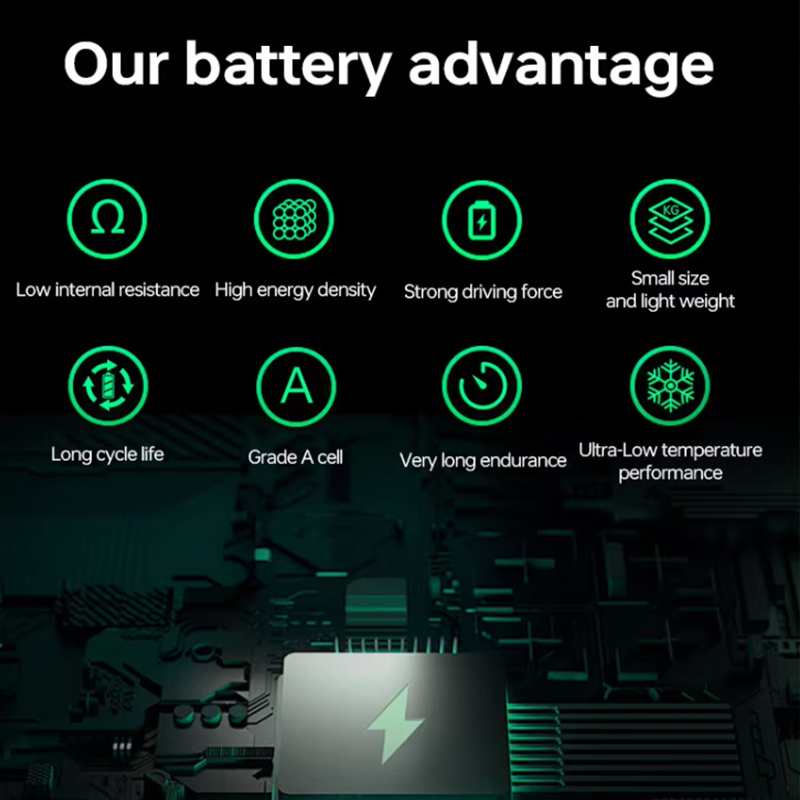
High-power batteries are the core component of the UAV power system. Different from ordinary energy storage batteries, their core characteristics focus on "high-rate discharge, stable output, and adaptation to complex working conditions". They are especially suitable for UAV types with high power performance requirements, such as multi-rotor and vertical take-off and landing (VTOL) UAVs. The following details the core advantages point by point, balancing professionalism and practicality.
. High Current Discharge for Stronger Power Output
The most prominent advantage of high-power batteries is their support for high-rate discharge, usually reaching 20C, 30C or even higher. They can release a large amount of current in a short time to provide sufficient power for UAVs. When a UAV takes off, climbs, flies against the wind, or performs rapid acceleration, the demand for power increases sharply. Ordinary batteries are prone to insufficient power and voltage drop, while high-power batteries can stably output large currents, ensuring a crisp take-off, powerful climbing, and stable flight even for heavy-load UAVs or large-propeller UAVs, completely solving the pain point of "weak power and inability to fly".
. More Stable Voltage for Safer Flight
Voltage stability is crucial for UAV flight safety. With excellent internal resistance control, high-power batteries have extremely small voltage drop during high-current discharge and can always maintain stable voltage. This feature can effectively avoid problems such as flight control system failure, image transmission interruption, and gimbal jitter caused by sudden voltage drops, and prevent dangerous situations such as UAV power limitation, altitude drop, and loss of control. Whether it is long-term hovering operation or high-intensity flight in complex environments, high-power batteries can provide stable power support for various electronic components of the UAV, greatly improving flight safety and reliability.
. Lower Heat Generation for Longer Service Life
High-power batteries adopt high-quality cells and optimized structural design, and their internal resistance is much lower than that of ordinary batteries. The smaller the internal resistance, the less heat generated during high-current discharge. This not only avoids problems such as bulging and accelerated aging of the battery due to overheating, but also effectively extends the cycle service life of the battery. In scenarios such as continuous UAV operation and high-intensity flight, high-power batteries can maintain a low operating temperature, with stable discharge performance without attenuation, reducing the frequency of battery replacement, lowering long-term use costs, and avoiding potential safety hazards caused by battery overheating.
. Strong Adaptability, Suitable for Multi-Rotor and VTOL UAVs
The core design of high-power batteries is to adapt to the complex flight conditions of UAVs, especially suitable for multi-rotor and vertical take-off and landing (VTOL) UAVs. Multi-rotor UAVs require continuous large currents to maintain hovering and attitude adjustment, and VTOL UAVs have extremely high peak currents during take-off and landing. Ordinary batteries cannot withstand such instantaneous loads, while high-power batteries can easily meet the power needs of these two types of aircraft, becoming their standard power choice. In addition, high-power batteries are compact in size and good in weight adaptability, which will not affect the load and endurance of the UAV due to their own weight, and are suitable for various specifications of industrial and consumer UAVs.
In summary, with the core advantages of "sufficient power, stable voltage, low heat generation, and wide adaptability", high-power batteries perfectly solve the power pain points of UAVs in high-intensity flight, heavy-load operation, and complex environments. They not only improve the flight performance and safety factor of UAVs, but also reduce long-term operation and maintenance costs, making them the core power guarantee for high-end UAVs and industrial UAVs.