How to Choose a Household Energy Storage Inverter? 5 Key Points Are Enough
The household energy storage inverter is the "core component" of a home energy storage system. Simply put, it converts the direct current stored in the battery into alternating current that can be used by household appliances such as air conditioners and refrigerators. It also manages power distribution, safety protection, and real-time monitoring. Its quality directly affects how long the entire energy storage system can last, how energy-efficient it is, and how safe it is. Many families feel confused when choosing an inverter. In fact, you don’t need complex calculations—just remember the following 5 points, and you can avoid pitfalls and choose a model that suits your home.
Point 1: Match the power appropriately and leave a margin. The power of the inverter determines how many appliances it can power at the same time. Before choosing, first calculate the total power of the electrical appliances you usually use at home, especially high-power appliances like air conditioners and water heaters—their starting power is 2-3 times higher than their normal power. It is recommended to leave a 20%-30% power margin. For example, if your home uses a maximum of 5kW of electricity at the same time, choose an inverter with a rated power of 6kW or more. This way, you won’t need to replace the inverter if you add more appliances later, and it also prevents the inverter from being damaged due to overloading. In addition, pay attention to whether the inverter can withstand high loads for a short time (such as operating at 110%-150% of its rated power for 10 seconds) to avoid failure when starting appliances.
Point 2: Check the conversion efficiency—the higher the efficiency, the more money you save. Conversion efficiency refers to the "degree of loss" when the inverter converts electricity. The higher the efficiency, the less electricity is wasted, and the more electricity bills you save every month. Currently, good household energy storage inverters have a conversion efficiency of over 95%, and some high-end models can even reach over 98%. When choosing, don’t just look at the "peak efficiency"—focus on the "European efficiency" instead. This standard is more comprehensive and can truly reflect how energy-efficient the inverter is in daily use.
Point 3: Safety first, and the protection level must be sufficient. Safety is always the top priority when choosing an inverter. On one hand, choose a model with complete protection functions, such as overload protection, short-circuit protection, over-temperature protection, over-voltage protection, and arc fault detection. These functions can protect the inverter, battery, and household appliances from damage. On the other hand, check the protection level: generally, choose one with IP54 or higher. If you need to install it outdoors or your home is relatively humid, choose IP65, which is waterproof and dustproof. In addition, the heat dissipation of the inverter is also important—models with dual fans and aluminum heat sinks have better heat dissipation and can last longer.
Point 4: Choose the right operating mode according to your home situation. Inverters have three main operating modes, suitable for different scenarios—there’s no need to blindly choose the expensive one. Grid-connected mode: Suitable for homes with solar panels. It can realize "solar power for personal use → excess power stored → remaining power fed into the grid", but it cannot be used during power outages. Off-grid mode: Suitable for remote areas without a power grid or for emergency use only. It must be used with an energy storage battery. Hybrid mode: Combines the advantages of the first two modes. It can switch automatically during power outages and work normally at ordinary times—it’s the best choice for most families.
Point 5: Value intelligence, scalability, and reliable after-sales service. Today’s inverters focus on intelligence. It’s best to choose one that can connect to WiFi/4G, allowing you to check power generation, power consumption, and battery status in real time via a mobile APP—no need to go to the inverter in person, which is very convenient. At the same time, consider future needs: choose a model that supports battery parallel connection and power upgrade. This way, if your home’s power demand increases later, you can expand the energy storage system easily without replacing the inverter. In addition, after-sales service is crucial. Prioritize brands that offer more than 5 years of warranty and a complete after-sales network to avoid worries about maintenance later.
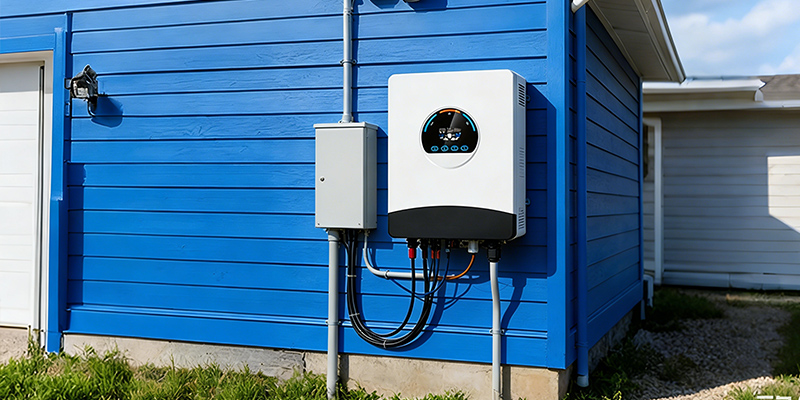
In summary, there’s no need to pursue "high configuration" when choosing a household energy storage inverter. Combine your home’s power needs, installation scenario, and budget, and choose rationally based on the 5 points above. If you’re looking for a reliable product that meets all the above requirements, the UFO-POWERhousehold energy storage inverter is worth considering. It is equipped with advanced technology, has an IP65 protection level, supports hybrid mode, and can be controlled intelligently via mobile phone. It also supports power expansion and offers a 7-year warranty, with three models (3kW, 5kW, 7kW) to suit both small and large households. Whether it’s efficiency, safety, adaptability, or after-sales service, the UFO-POWER inverter perfectly meets household energy storage needs, providing a safe and efficient energy solution.